
How important is it to select patients for surgery or chemoradiotherapy up front?
Surgical Attrition
Many patients with Stage II to III non-small cell lung cancer (NSCLC) are missing their chance at a definitive, multimodal treatment approach1
In a retrospective, US-based observational cohort study of 543 patients with Stage II
or III NSCLC*
Up to
~35%
of patients treated initially with neoadjuvant immunotherapy + chemotherapy never received surgery

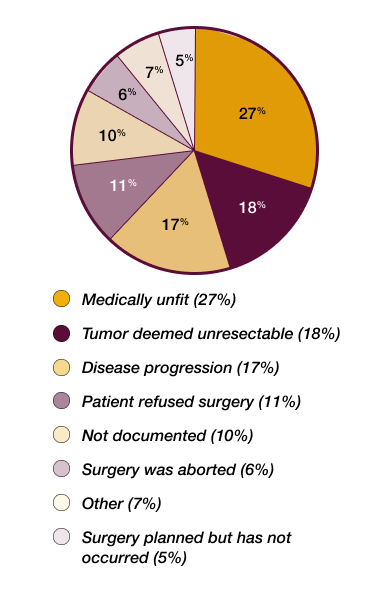
Data also demonstrated that patients who don’t receive surgery are less likely to receive a complete, radiation-based, curative intent approach
~44%
of those patients who did not undergo surgery never went on to receive radiation in any form
There should be a high probability of complete resection (R0) before initiation of a neoadjuvant approach.
Neoadjuvant therapy to induce resectability is an unproven approach2†
NCCN Clinical Practice Guidelines in Oncology (NCCN Guidelines®) for NSCLC V.7.2026
*
A retrospective, observational cohort study of the US-based, EHR-derived, deidentified Flatiron Health Research Database. The study assessed: 1) real-world rate of surgery following neoadjuvant IO + CT; 2) reasons for preoperative attrition; and 3) subsequent treatment patterns in 543 patients with Stage II or III NSCLC who received treatment with nivolumab and chemotherapy between January 2022 and October 2023. Per approved protocol, descriptive statistics were utilized for patient characteristics, surgery rates, and treatment patterns.1
†
High probability refers to the expectation that an R0 resection is feasible and achievable, as incomplete (R1/R2) resection is associated with poor outcomes.3
Determining Resectability
The Society of Thoracic Surgeons (STS) and NCCN have provided updated recommendations for determining resectability
STS consensus summary of surgical resectability for NSCLC3
| Non-bulky | Bulky | |||||
|---|---|---|---|---|---|---|
| N0 | N1 | N2 single | N2 multistation | N2 single | N2 multistation | |
| T1/T2 | Resectable | Resectable | Resectable | Potentially resectable |
Potentially resectable |
Unresectable |
| T3 | Resectable | Resectable | Resectable | Potentially resectable |
Potentially resectable |
Unresectable |
| T3 (Pancoast) | Potentially resectable |
Potentially resectable |
Unresectable | Unresectable | Unresectable | Unresectable |
| T4 size | Potentially resectable |
Potentially resectable |
Unresectable | Unresectable | Unresectable | Unresectable |
| T4 satellite | Potentially resectable |
Potentially resectable |
Potentially resectable |
Unresectable | Unresectable | Unresectable |
| T4 invasion | Potentially resectable |
Potentially resectable |
Unresectable | Unresectable | Unresectable | Unresectable |
N2 Disease
National Comprehensive Cancer Network® (NCCN®) has provided updated recommendations regarding N2 disease and resectability2
The determination of the role of surgery in a patient with N2-positive lymph nodes should be made prior to the initiation of any therapy
Selected patients with N2 disease (fit, single-station, non-bulky N2, requiring only lobectomy) may be considered for systemic therapy followed by surgery
The presence of N2-positive lymph nodes substantially increases the likelihood of positive N3 lymph nodes
NCCN Guidelines® for NSCLC V.7.2026
Diagnosis and Staging of Unresectable Stage III NSCLC
Watch the lung cancer MDT at AdventHealth discuss diagnosis and staging for optimal NSCLC care.
Featuring: Dr Fortune Alabi, Pulmonologist; Dr Chung-Che (Jeff) Chang, Molecular Pathologist; Dr Charles (Wes) Hodge, Radiation Oncologist; Dr Tarek Mekhail, Medical Oncologist; Dr Mark Socinski, Medical Oncologist Brenda Rzeszutko, Nurse Navigator
Narrator:
Diagnosis and staging of unresectable Stage III NSCLC.
Narrator:
The views and opinions expressed in this video are those of the individual oncology specialists and do not represent the views or opinions of AstraZeneca. This video contains anecdotal information gathered from a discussion with oncology specialists based on their opinions/experiences. Recommendations are general and may vary with patients. At the time of this filming, the Healthcare Professionals featured were in the roles and at the institutions indicated.
Narrator:
Topics discussed in this video include: Ensuring a complete diagnosis. Imaging and pathological staging. Testing. And determining resectability.
Dr Subramanian:
Hello, I’m Dr Janakiraman Subramanian, I’m a medical oncologist. Welcome to our video series on the changing landscape of unresectable Stage III non-small cell lung cancer. In our first video of this series, we’ll be talking about the diagnosis and staging of unresectable Stage 3 non-small cell lung cancer.
Dr Mahajan:
Thank you, Ram. My name is Bobby Mahajan, and I’m an interventional pulmonologist.
Dr Chun:
And I’m Stephen Chun. I’m a radiation oncologist.
Dr Sepesi:
Hi, I am Dr Boris Sepesi. I’m a thoracic surgeon.
NN Roy:
Hi, and I’m Megan Roy. I’m an oncology nurse navigator.
Narrator:
Our first topic is ensuring a complete diagnosis, focusing on imaging and pathological staging.
Dr Subramanian:
What do you think is needed for a complete diagnosis of unresectable Stage 3 non-small cell lung cancer?
Dr Mahajan:
In a perfect world, all eligible patients with lung cancer would be referred to a multidisciplinary oncology team so that oncologists and thoracic surgeons can discuss the case in detail and determine treatment options and resectability.
Dr Mahajan:
At our institution, a complete diagnosis occurs when the appropriate biopsy is led and we’ve performed the lung lesion to diagnose and stage the patient in one procedure. Patients may see various physicians such as pulmonologists, oncologists, interventional radiologists, who are unable to provide the complete diagnosis and stage all at one procedure.
Dr Mahajan:
This approach optimizes efficiency for patient care and reduces time from identification to treatment. Once the patient is seen by the thoracic surgeon following complete diagnosis and staging, the thoracic surgeon would conduct a full workup to determine initial resectability. That workup should include a medical history, physical examination, assess comorbidities and performance status, order chest CT scans, and check labs, PFTs, EKGs, et cetera.
Dr Subramanian:
As the nurse navigator for the thoracic oncology program, how do you see your role in making sure that the patients have the appropriate diagnosis and staging for their unresectable Stage 3 non-small cell lung cancer?
NN Roy:
So, a lot of times, the nurse navigator is the first contact a patient has after finding out they have an abnormal CAT scan. So, we play a crucial role of reviewing the records, making sure we get the images there, and then setting them up with our pulmonology team or our thoracic surgeons to try to get that process as seamless as possible and get them in as quick as possible.
Dr Subramanian:
I agree fully with what you said. In my experience, I’ve found that nurse navigators are the glue that hold our multidisciplinary team together and are essential for helping our patients through their lung cancer journey.
Dr Subramanian:
When you do your diagnosis and staging, when do you get your PET CT and your brain MRI scans ordered? When do you think they should be done?
Dr Mahajan:
In my experience, I consider the whole body PET and brain MRI to be essential for determining the appropriate care pathway after bronchoscopy and mediastinal staging are performed. The false-negative rate of determining mediastinal involvement of malignancy can be as high as 15% to 20%, so a PET should not be the only means of staging. This only provides a clinical stage. Instead, combining an EBUS bronchoscopy with clinical staging through PET should be performed, and that EBUS will allow us to sample mediastinal nodes at the same time as obtaining a diagnosis. The PET should be used only for evaluation of distant metastases, not as a primary means of staging.
Dr Sepesi:
I also think that it’s important to point out that not every community setting has the expertise of very skilled interventional pulmonologists like Dr Mahajan to do the transbronchial biopsies and staging via EBUS, so maybe using the latest robotic technology. And oftentimes surgeons will also act as perhaps interventional pulmonologists or they act as surgeons to obtain diagnostic tissue.
Dr Chun:
Even more reason for the specialists that are available to be talking to each other, especially the medical oncologist, the surgeon, and the pulmonologist, to ensure a complete diagnosis.
Dr Chun:
In lung cancer, we know that clinical staging with imaging as well as pathologic staging are both necessary to complete staging. While imaging with CT scans, PET scans, and certainly MRIs of the brain are crucial steps, they often only tell part of the story with respect to the status of pulmonary mediastinal lymph nodes and a bronchial tumor extension, et cetera.
Dr Subramanian:
I’d like to share that as we speak, I have a patient being treated who we initially thought had T3 N0 disease, which we were going to treat conceivably with radiation alone. Because of the bronchoscopy, they found an N1 or hilar node, which meant the difference between including that tumor in the radiation field or not, but also the addition of concurrent chemotherapy, which obviously has an enormous impact on that patient’s outcome. And so the more accurately we can characterize the stage of patients, the better we can ensure that they’re treated correctly.
Dr Sepesi:
Why is it important to have a multidisciplinary discussion prior to determining resectability?
Dr Subramanian:
I think that it is extremely important to have multiple providers meet, especially at these more challenging tumors. And so this way we all come together and we can analyze the case to see what’s in patient’s best interest with the least amount of morbidity, but the highest efficiency for the treatment.
Narrator:
This next section covers testing as part of ensuring a complete diagnosis.
Dr Subramanian:
In early-stage as well as locally advanced non-small cell lung cancer, checking for driver mutations of the tumor is now crucial because that can affect the treatment plan for these patients.
Dr Subramanian:
What approach do you take when you are sampling these tissue? What are the key factors you’re looking for to ensure you get an adequate tissue sample when you do the biopsy?
Dr Mahajan:
In my practice, tissue is always the issue. Lung cancer is not just diagnosing, but also getting next-generation sequencing. So you don’t just check to see if it’s adenocarcinoma or a nonsquame, but there are biomarker tests that need to be obtained with required adequate tissue and allows us to make decisions later on in the care continuum.
Narrator:
Our next topic is determining resectability in NSCLC.
Dr Sepesi:
I think the thoracic surgeon is really crucial in actual treatment of lung cancer, and this is not just Stage 1, but Stage 2, Stage 3, making decisions regarding resectability and operability of those patients.
Dr Sepesi:
So I specifically look at the size of the tumor, location of the tumor, location of the tumor to the chest wall, to visceral pleura, parietal pleura, other lobes. I look at whether this would be resectable with sublobar resection, lobectomy, or pneumonectomy because all of this has impact in terms of how much lung function we preserve.
Dr Sepesi:
The word operability truly relates to patient’s physiologic status. For example, their pulmonary function testing, their cardiovascular status, their resilience, their exercise ability. In my opinion, some patients may be too frail for surgery. And so those patients should most likely not be operated on even though they technically, potentially could be resectable, and then they’re deemed “unresectable” in this setting. And I believe that surgical planning and treatment planning should truly be based on the initial disease distribution, and those decisions should be made up front in a multidisciplinary setting.
Dr Chun:
And I’m in total agreement with Dr Sepesi on the importance of multidisciplinary evaluation to determine operability. Really, a number of factors that are involved here, including tumor anatomy, patient age, performance status, comorbidities—all of these things can impact how a patient’s going to do after surgery. These characteristics sometimes have a bearing because morbidity following an invasive surgery, as Dr Sepesi alludes to, might not be worth the benefit of removing the tumor invasively.
Narrator:
In summary, the main takeaways from this discussion include the following: The MDT is necessary to make a complete diagnosis of unresectable Stage III NSCLC. Prior to making treatment decisions, driver mutation and immune status should be assessed. Correct staging is essential for determining treatment. And, finally, operability should be determined by the MDT based on patient characteristics.
Dr Subramanian:
This brings us to the end of our first video, but be sure to look for other videos in the series. Thank you for watching.
KEY POINTS
In real-world practice, many patients with Stage II to III NSCLC are missing their chance at a definitive, multimodal treatment approach
- In a retrospective, US-based observational cohort study of 543 patients with Stage II to III NSCLC, ~35% of those treated initially with neoadjuvant IO + CT and documented neoadjuvant intent never received surgery1
- ~44% of those patients who did not
undergo surgery never went on to receive radiation in any form1 - The Society of Thoracic Surgeons has provided updated guidance for determining resectability3
- According to NCCN Guidelines, there should be a high probability of complete resection (R0) before initiation of a neoadjuvant approach. Neoadjuvant therapy to induce resectability is an unproven approach2
CT=chemotherapy; EHR=electronic health record; IO=immuno-oncology; NCCN=National Comprehensive Cancer Network® (NCCN®).
References: 1. Lee J, Simmons D, Mulrooney T, et al. Real-world surgical patterns following immuno-oncology exposure in US patients with stage II and III non-small cell lung cancer (REASON study). Presented at: ASCO Annual Meeting; May 30-June 3, 2025; Chicago, IL. 2. Referenced with permission from the NCCN Clinical Practice Guidelines in Oncology (NCCN Guidelines®) for Non-Small Cell Lung Cancer V.7.2026. © National Comprehensive Cancer Network, Inc. 2026. All rights reserved. Accessed August 7, 2026. To view the most recent and complete version of the guideline, go online to NCCN.org. NCCN makes no warranties of any kind whatsoever regarding their content, use or application and disclaims any responsibility for their application or use in any way. 3. Kim SS, Cooke DT, Kidane B, et al. The Society of Thoracic Surgeons expert consensus on the multidisciplinary management and resectability of locally advanced non-small cell lung cancer. Ann Thorac Surg. 2025;119(1):16-33.
 This information is intended for US Healthcare Professionals only.
©2026 AstraZeneca. All rights reserved. US-108160 Last Updated 7/26